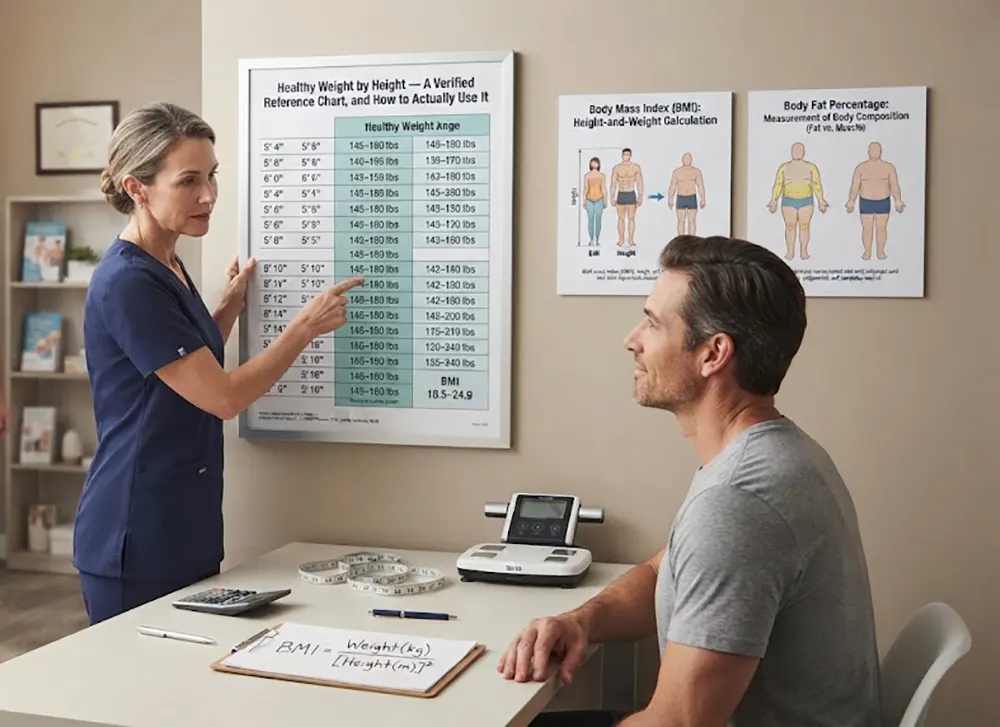
A Verified Reference Chart and How to Actually Use It
"What should I weigh for my height?" is one of the most commonly searched health questions, and the honest answer is a range, not a single number. That range comes directly from the standard BMI formula, the same calculation covered throughout this guide series, applied in reverse to find the weight boundaries for a given height rather than calculating BMI from a known weight.
This guide provides a verified height-to-weight reference chart, explains how to use the range, and covers what the range cannot tell you on its own.
Healthy Weight Chart by Height
The following ranges are calculated directly from standard BMI healthy-weight boundaries: 18.5 at the low end, 24.9 at the high end, applied to each height. Every figure was independently recalculated before publishing to confirm accuracy.
Figure 1: Healthy weight range by height, calculated from the standard BMI formula. Each value was recalculated independently rather than assumed accurate from an existing source.
Why the Range Widens With Height
The healthy weight range isn't a fixed number of kilograms wide; it expands as height increases. This isn't arbitrary; it's a direct consequence of the BMI formula itself, which divides weight by height squared. Because height is squared in the denominator, small differences in height produce progressively larger differences in the corresponding weight range.
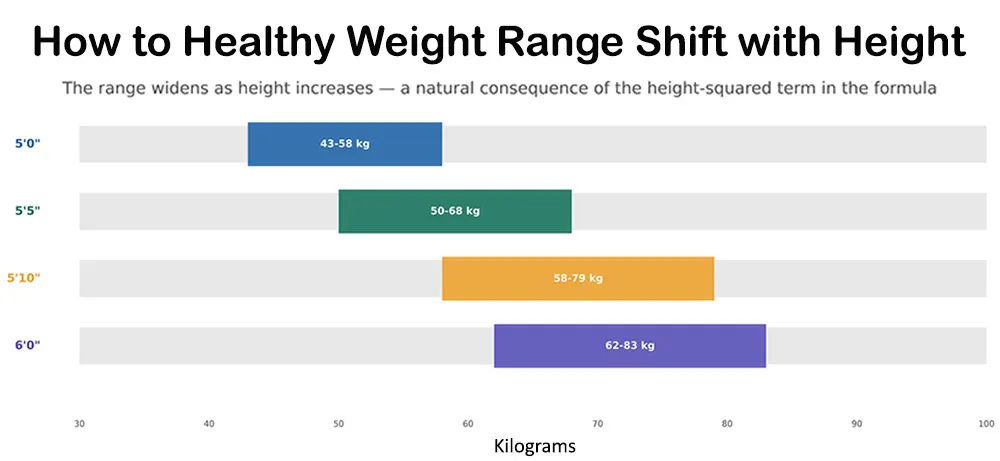
Figure 2: The healthy weight range visually widens at greater heights — a mathematical consequence of the height-squared term in the BMI formula, not an inconsistency in how the range is calculated.
At 5'0", the range spans 15 kg. At 6'0", it spans 21 kg a meaningfully wider window for the same BMI boundaries, simply because of how the formula scales with height.
How to Use This Chart
The chart provides a reference range, not a fixed target to hit exactly. How a result relates to that range should inform the next step, not dictate a specific numeric plan.
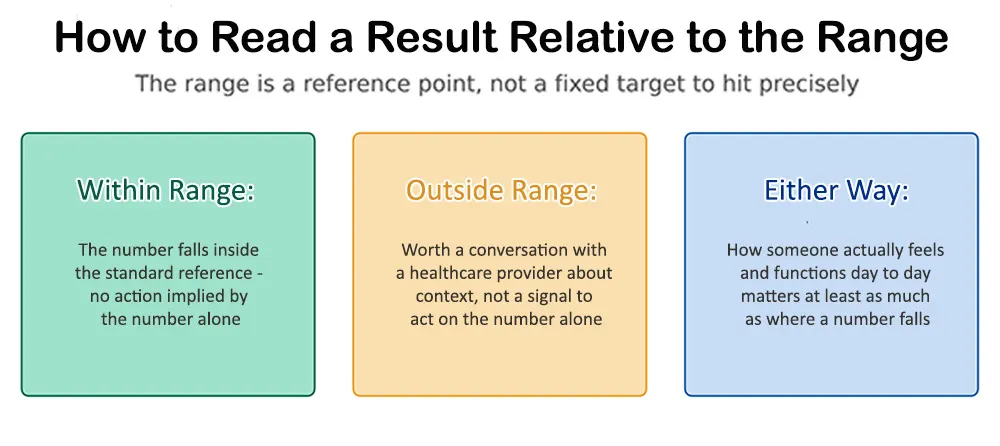
Figure 3: Falling within the range, outside it, or anywhere in between — the range is a reference point for a broader conversation, not a verdict to act on by itself.
For someone whose weight falls within the range, the reasonable takeaway is that the number doesn't raise a concern on its own, nor is it necessarily a signal to change anything. For someone outside the range, the more useful next step is usually a conversation with a healthcare provider about the full context: activity level, muscle mass, family history, rather than treating the chart itself as a directive. This guide isn't meant to recommend a specific numeric weight change, calorie target, or timeline; that kind of individualized planning belongs with a qualified healthcare provider who can account for factors a general chart can't see.
What This Range Doesn't Capture
A height-and-weight range, however precisely calculated, is still built on the same underlying limitation as BMI itself: it says nothing about what the weight is actually made of, or how someone is actually living.
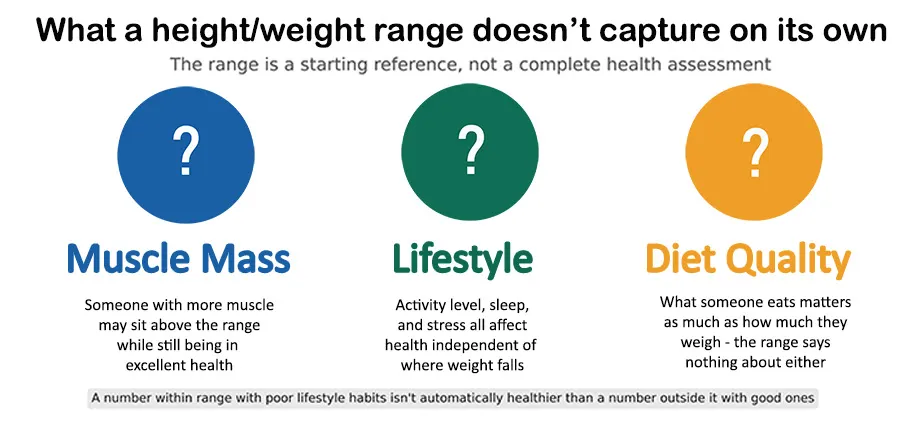
Figure 4: Muscle mass, lifestyle, and diet quality all affect health regardless of where a number falls on this chart—none of which the chart itself can measure.
Muscle mass: someone with significant muscle mass may fall above the range on this chart while being in excellent health; the chart, like BMI itself, cannot distinguish muscle from fat.
Lifestyle: activity level, sleep quality, and stress all meaningfully affect health in ways a weight range alone cannot reflect.
Diet quality: what someone eats matters independent of how much they weigh; the range says nothing about either nutritional quality or eating patterns.
A number within the range paired with poor underlying habits isn't automatically healthier than a number outside the range paired with good ones. The range is a starting reference point, most useful alongside, not instead of, how someone actually feels and functions day to day.
Frequently Asked Questions
How is a healthy weight range calculated for a given height?
By applying the standard BMI healthy range (18.5 to 24.9) to a specific height, solving for the corresponding weight boundaries. This is the same BMI formula used throughout, applied in reverse starting from a known height and BMI range to find weight, rather than starting from weight and height to find BMI.
Why does the healthy weight range get wider at greater heights?
Because the BMI formula divides weight by height squared. Since height is squared in the calculation, small increases in height produce progressively larger corresponding increases in the weight range width, a mathematical property of the formula, not an inconsistency in the chart.
What should be done if a weight falls outside the healthy range?
The most useful next step is a conversation with a healthcare provider, who can factor in muscle mass, activity level, and overall health context details a general height-and-weight chart cannot see. This guide is not positioned to recommend a specific weight-loss or weight-gain target; that kind of individualized guidance depends on factors only a qualified provider can properly assess.
Is this chart accurate for everyone?
It reflects the standard BMI-based healthy weight boundaries, which apply reasonably well at a population level but carry the same limitations as BMI itself: no adjustment for muscle mass, frame size, age, or body composition. It's a starting reference point, not an individualized assessment.
Conclusion
A healthy weight range by height answers a common, reasonable question with the honest complexity it deserves: a range, not a single target number, and one that widens meaningfully as height increases due to how the underlying BMI formula is constructed.
The chart in this guide reflects verified, independently recalculated figures rather than assumed-accurate numbers worth mentioning because even small calculation errors in a chart like this can shift where someone believes they fall relative to a healthy range. What the chart cannot do, no matter how precisely calculated, is account for muscle mass, lifestyle, or diet quality the factors that determine whether a given weight actually reflects good health for a specific individual.
Used as intended, a reference point for a broader conversation, ideally with a healthcare provider, this kind of chart is genuinely useful. Used as a fixed target to hit at any cost, it uses a simple formula to answer a question it was never built to answer completely on its own.