
Principal, Interest & Monthly Payments — How Loan Calculations Actually Work
A $300,000 mortgage at 6% for 30 years costs $347,514 in interest alone. That is more than the house. Most people who sign that loan have never seen that number written down before they close.
That gap between what borrowers think they are agreeing to and what they are actually agreeing to is exactly the problem a loan calculator solves. Enter a principal, an interest rate, and a term. Get back a monthly payment, a total interest figure, and a complete schedule showing where every dollar goes for the life of the loan. The math is not hidden. It has always been available. The calculator just makes it impossible to avoid.
Lenders are not obligated to present total interest costs prominently. A loan calculator is. That asymmetry is the reason to use one before signing anything, not after.
What Is a Loan Calculator and How Does It Work?
A loan calculator takes three inputs: the amount borrowed, the interest rate, and the repayment period, and returns the monthly payment required to pay off the debt in full. That is the core function. Everything else is built on top of it.
The monthly payment answers the budget question. The total interest answers the cost question. Most borrowers ask the first and skip the second, which is precisely what a lender's marketing is structured to encourage. These two figures move in opposite directions: a longer term lowers the payment and raises the cost. A loan calculator makes that trade-off visible in under a minute.
Most tools handle standard amortizing loans: mortgages, auto loans, personal loans — where each payment is fixed, and the balance reaches zero at the end of the term. That structure is what the PMT formula was built to solve.
The Formula Behind Every Monthly Payment
The standard loan payment formula is:
M = P × [r(1 + r)ⁿ] / [(1 + r)ⁿ – 1]
Where M is the monthly payment, P is the principal, r is the monthly interest rate (annual rate divided by 12), and n is the total number of payments. On a $20,000 loan at 6% APR over five years: r = 0.005, n = 60, M = $386.66. Sixty equal payments, nothing left over.
A Quick Example
The $20,000 borrowed costs $23,199.60 to repay. That $3,199.60 is the price of using the lender's money for five years. Whether that price is reasonable depends on the alternatives, not on whether the monthly payment feels manageable.
Using a Loan Calculator
Inputs and Outputs
Four inputs drive every loan calculation. Some tools add a fifth for extra payments, which is worth using.
- Loan amount: The principal, the total sum being borrowed. For a mortgage, this typically excludes the down payment. For an auto loan, it may include taxes and fees depending on the tool.
- Interest rate: Expressed as an annual percentage rate (APR). APR includes the base interest rate plus certain lender fees, which is why it is almost always higher than the advertised rate. Using APR rather than the base rate gives a more accurate cost picture.
- Loan term: The repayment period in years or months. This is the input borrowers adjust most casually and should adjust most carefully. Extending the term by five years to lower the monthly payment is one of the most expensive decisions in consumer lending; the savings per month are real, but the total interest cost is larger.
- Extra monthly payment (optional): An amount above the required minimum applied directly to principal. Even $50 or $100 per month produces significant interest savings over a long loan term.
The outputs are monthly payment, total interest paid, total amount paid, and an amortization schedule. The monthly payment gets most of the attention. The total interest figure is the more important number.
The Amortization Schedule
Why Interest Feels Front-Loaded
A common frustration among first-time mortgage holders: two years of on-time payments, and the balance has barely moved. This is not a lender trick. It is how amortization works.
Interest is calculated on the current outstanding balance. In month one, the balance is at its maximum, so is the interest charge. As principal falls, the interest portion of each payment shrinks, and the principal portion grows. The payment stays fixed. The split inside it changes every month.
On the $20,000 five-year loan at 6%, the first payment of $386.66 breaks down as $100.00 in interest and $286.66 toward principal. By month 59, the same payment is $5.74 in interest and $380.92 toward principal. Same loan. Same borrower. Same payment. Only the balance has changed.
First and Last Months Compared
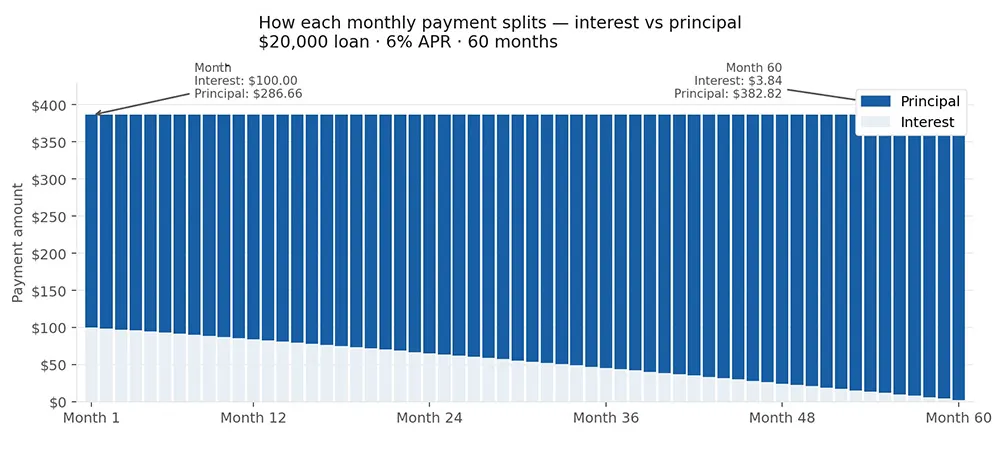
Interest (light) vs principal (blue) split across 60 monthly payments on the $20,000 loan at 6%.
Loan Types
One Formula, Many Applications
The same amortization formula runs every loan type. What changes is which inputs matter most and which additional costs each category typically adds.
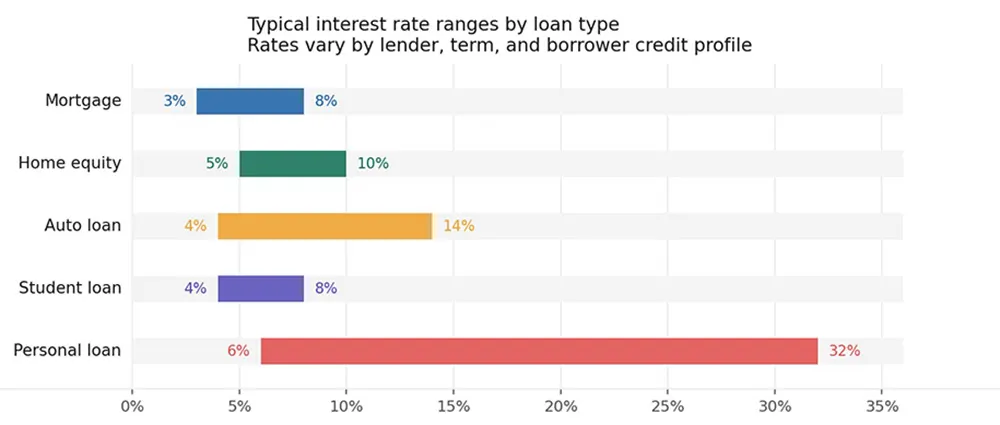
Typical interest rate ranges by loan type. Personal loans span the widest range.
Mortgage Calculator
A mortgage calculator needs to go beyond principal, rate, and term. Private mortgage insurance (PMI) is required when the down payment is below 20%, typically 0.5% to 1.5% of the loan amount annually. Property taxes and homeowner's insurance are collected via escrow as part of the monthly payment.
The gap matters more than most buyers expect. A $300,000 mortgage at 6% for 30 years produces a loan payment of $1,798.65. With PMI, taxes, and insurance factored in, the actual monthly obligation is typically $2,200 to $2,500. Budgeting against the loan payment alone, which is what most listings encourage, understates the real cost by several hundred dollars a month. Use a calculator that includes these costs, not one that stops at the loan payment.
Auto Loan Calculator
Car loans run 36 to 72 months, which means the interest front-loading is less dramatic than a mortgage, but the rate is usually higher. A $35,000 vehicle at 7% for 72 months carries total interest of roughly $7,900. The same loan at 48 months costs $838 per month but only $2,200 in interest. That $242 monthly difference costs $5,700 over the longer term. Which is the better deal depends entirely on cash flow and how long the car will be kept.
Personal Loan Calculator
Personal loans are the cleanest calculation: principal, rate, term, nothing else. They are also where the rate spread is most punishing. From roughly 6% for excellent credit to over 30% for poor credit, the same $10,000 borrowed over three years costs $946 in interest at one end of that range and $3,068 at the other. That $2,122 difference is a strong argument for checking the credit score before applying, not after receiving the rate offer.
Student Loan Calculator
Federal student loans carry multiple repayment structures: standard 10-year, graduated, extended, and income-driven plans, each producing a different monthly payment and total interest cost over the life of the loan. A student loan calculator that models all four side by side turns an abstract choice into a concrete comparison. The right answer depends on income trajectory, not on which plan has the lowest starting payment.
Home Equity Loan Calculator
Home equity loans borrow against the difference between a property's value and its outstanding mortgage balance. Most lenders allow borrowing up to 80% of property value minus the existing mortgage. The rate is typically lower than a personal loan because the property secures the debt, which also means the property is at risk if payments are missed. That trade-off belongs in the calculation, not just the marketing copy.
Debt Consolidation Calculator
Debt consolidation makes mathematical sense when the consolidation rate is meaningfully lower than the weighted average rate of the existing debts and when the term is similar. Three credit cards totaling $15,000 at 22% APR cost over $7,000 in interest at minimums. A consolidation loan at 12% APR for four years costs $3,960. The monthly savings are $55; the interest savings are over $3,000.
The consolidation only works if the original balances are closed and stay closed. Borrowers who consolidate and then rebuild the same credit card balances end up with both the consolidation loan and fresh card debt, which is materially worse than the original situation. The calculator shows what consolidation saves. The discipline to avoid re-accumulating is outside what any calculator can model.
Extra Payments, Biweekly Schedules, and Loan Comparisons
The most financially consequential feature of a loan calculator is one many borrowers never use: the extra payment field.
Extra Monthly Payments
On a $200,000 mortgage at 6% for 30 years, the required payment is $1,199.10 and total interest is $231,676. Adding $100 to each payment pays the loan off in 25.5 years and reduces total interest to roughly $197,000. That extra $100 per month, over 25.5 years, saves $34,676 more than the cumulative extra amount paid. The savings exceed the extra payment because every early dollar avoids future interest for every remaining month.
On the $20,000 five-year loan, adding $25 per month cuts the term by nearly a year and saves over $400. The numbers scale with loan size. The principal does not change.
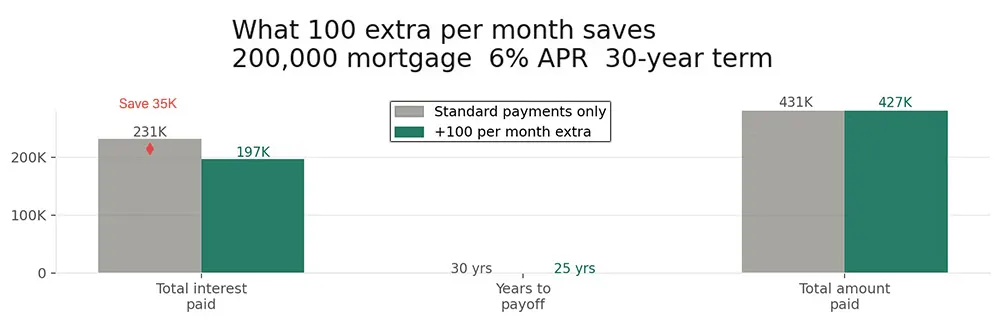
Adding $100/month to a $200,000 mortgage saves $35K in interest and cuts 4-5 years.
Biweekly Payment Schedule
Switching from monthly to biweekly payments, half the monthly amount every two weeks generates 26 half-payments per year, which equals 13 full monthly payments instead of 12. On a $200,000 mortgage at 5% for 30 years, this cuts the term to roughly 25.5 years and saves over $34,500 in interest.
The caveat is practical, not mathematical: some lenders do not accept biweekly payments, and others charge a setup fee for the service. Lenders are aware that biweekly schedules accelerate payoff and reduce their interest income; the fee is not accidental. Making one extra full payment per year achieves approximately the same result without the setup cost.
Loan Comparison Calculator
The 15-year versus 30-year mortgage comparison is the most instructive one a borrower can run, because the numbers make the true cost of a lower monthly payment concrete.
The 30-year loan costs $137,520 more in interest. The $435 monthly savings is real, but $137,520 is also real, and it is a figure that rarely appears in a lender's presentation. For borrowers who genuinely cannot afford the 15-year payment, the 30-year is the right product. For borrowers who could afford the higher payment but choose not to, it is the most expensive convenience in personal finance.
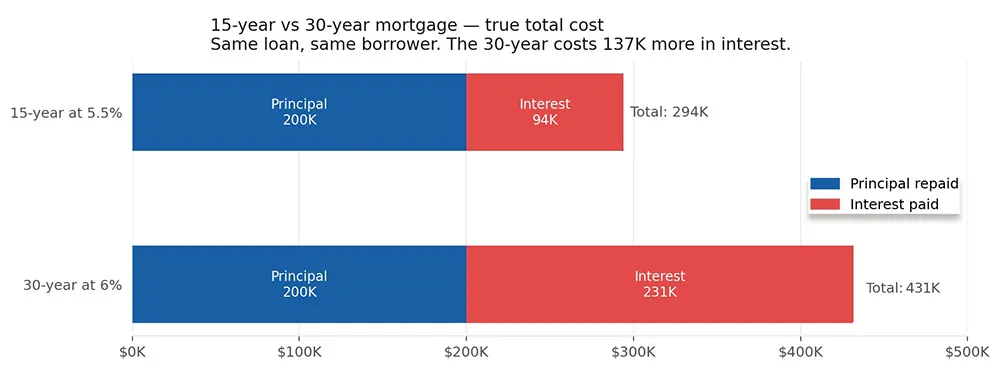
Total cost comparison — 15-year vs 30-year mortgage on $200,000.
Understanding True Loan Costs — APR, DTI, and Prepayment Rules
APR vs. Interest Rate
The interest rate is the base cost of borrowing. APR includes the rate plus mandatory fees: origination, closing costs, broker fees. APR is almost always higher than the advertised rate and is the accurate cost measure.
A lender advertising 5.5% on a $300,000 mortgage with $4,500 in fees has an effective APR closer to 5.8%. Over 30 years, that 0.3% difference compounds to roughly $50,000. Compare APRs across lenders, not interest rates. Two loans at the same nominal rate can have materially different APRs depending on fee structures.
One important qualification: APR assumes the loan runs to its full term. A borrower planning to refinance or sell in five years should not be comparing 30-year APRs; they should calculate total cost over the expected holding period. Spreading $4,500 in fees across five years produces a much higher effective rate than spreading it across thirty.
Debt-to-Income Ratio
DTI, total monthly debt payments divided by gross monthly income, is the primary lens lenders use to assess repayment capacity. Most conventional mortgage lenders cap it at 43%.
A borrower earning $6,000 gross per month with $1,100 in existing monthly debts and an $800 new loan payment has a DTI of 31.7% ($1,900 / $6,000). That is within conventional limits.
What DTI does not measure is buffer. Approval at 43% DTI leaves little room for a car repair, a medical bill, or a month of reduced income. Approvable is not the same as comfortable.
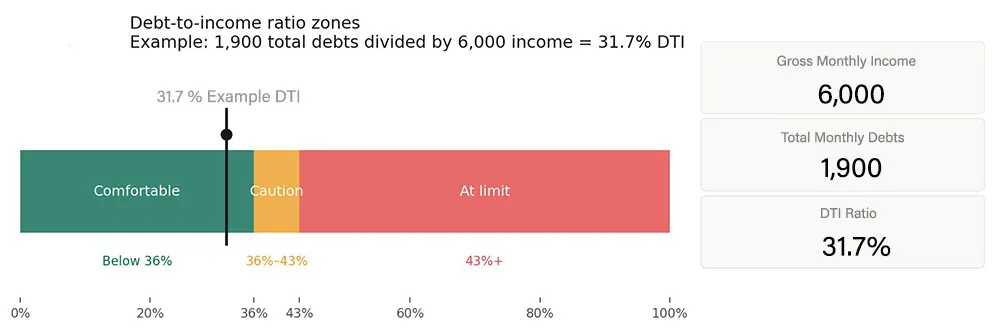
DTI zone diagram with the worked example (31.7%) marked in the comfortable range.
Prepayment Penalties
Some loan agreements charge a fee for early payoff: a percentage of the remaining balance or a set number of months' interest. The arithmetic is simple: if paying off early saves $500 in future interest but triggers a $200 penalty, the net saving is $300. If the penalty is $600, early payoff is not worth it.
Prepayment penalties are more common in older auto loans and some personal loans. Most modern mortgages and federal student loans do not carry them, but always check the agreement before planning around early payoff.
The Rule of 78
The Rule of 78 front-loads interest more aggressively than standard amortization. In a 12-month loan, the sum of digits 1 through 12 equals 78. The lender assigns 12/78 of the total interest to month one, 11/78 to month two, and so on. A borrower who pays off in month two has paid 23/78, nearly 30% of the total interest despite completing only 16.7% of the term. Early payoff saves almost nothing.
The Rule of 78 has been banned for most consumer loans in many jurisdictions, but it persists in some auto and personal loan products. It is not disclosed on marketing materials. Ask the lender which method applies before signing any loan where early payoff is part of the plan.
Fixed vs. Variable Rate
Fixed rates hold for the life of the loan. Variable rates adjust periodically, usually annually after an initial fixed period tied to a benchmark like SOFR or the prime rate.
A 5/1 ARM at 4.5% with a 2% annual cap and 5% lifetime cap could reach 9.5% by year seven. A borrower planning to sell or refinance before the adjustment window accepts the lower initial rate without facing the rate risk. A borrower expecting to stay for 20 years takes on genuine uncertainty about what the payment will be in year six.
The standard advice to choose a fixed rate if the loan will be held long-term, and an ARM only if the exit is planned, is correct but incomplete. The more useful exercise is to run the worst-case ARM scenario through a calculator and ask whether that payment is survivable. If it is not, the initial rate saving is not worth the risk.
Manual Calculation
The Formula Behind the Tool
For anyone who wants to verify a tool's output or build their own, the PMT formula works in any spreadsheet. One worked example:
- $20,000 loan, 6% APR, 5 years
- Monthly rate r = 0.06 / 12 = 0.005
- n = 60 payments
- (1.005)^60 ≈ 1.34885
- M = 20,000 × (0.005 × 1.34885) / (1.34885 – 1) = $386.66
The calculation matches every standard loan calculator. The math is not proprietary — the tool just eliminates the arithmetic.
Building a Loan Amortization Schedule in Excel
Set up inputs: Enter loan amount, annual rate, and term in cells A2, B2, C2. In D2, enter =PMT(B2/12, C2*12, -A2). For a $20,000 loan at 6% over 5 years, the result is $386.66.
Build the amortization table: Headers in row 5: Month, Starting Balance, Payment, Interest, Principal, Ending Balance. In row 6: Month = 1, Starting Balance = 20000, Payment = $D$2, Interest = B6*(B$2/12), Principal = C6-D6, Ending Balance = B6-E6. In row 7, Starting Balance = F6, then copy the remaining formulas down. Drag to row 65 for 60 months.
Sum total interest: =SUM(D6:D65) returns $3,199.60. The same structure works in Google Sheets; PMT, IPMT, and PPMT functions are identical.
This schedule models the loan repayment only. It does not account for the mortgage interest tax deduction, PMI cancellation once equity crosses 20%, or escrow adjustments. Those affect the true cost of homeownership but are separate calculations.
Loan Calculation in Code
For developers integrating loan calculation into applications, the formula is the same in any language.
JavaScript
Floating-point rounding across 360 iterations produces a small cumulative error in the final balance. The standard fix is to cap the final payment at the actual remaining balance.
Python
One distinction that matters in markets outside North America: the reducing balance method used in both examples above calculates interest on the outstanding principal each period. A flat rate method calculates interest on the original principal for the full term. Flat rate 6% on $20,000 for 5 years produces $6,000 in interest; reducing balance produces $3,200. If a lender quotes a flat rate, the effective APR is almost double the stated figure. Always confirm which method applies.
Stress Testing — What If the Numbers Change?
Running a calculation at the quoted rate answers the baseline question. Stress testing answers the one borrowers rarely think to ask: what happens if the assumptions change?
Interest Rate Stress Test
A 5/1 ARM at 4% on a $250,000 loan starts at $1,193 per month. With a 2% annual cap and 5% lifetime cap, the rate could reach 9% by year seven, pushing the payment to approximately $1,850, a 55% increase. The stress test question is direct: can that payment be covered if necessary? If the answer is no, the initial rate discount is not worth the risk. A fixed-rate loan at a higher initial rate eliminates the question.
Income Shock Stress Test
A $1,500 mortgage payment on $6,000 gross monthly income sits at 25% DTI. If income drops to $4,500 due to a job change or a reduction in hours, the same payment becomes 33% DTI. That shift is manageable for most budgets. It is worth knowing before the income drop, not during.
How Much Loan Can Be Afforded
A Complete Walkthrough
The question 'how much can be borrowed?' has a more specific answer than most lenders will volunteer. Working through it produces a number based on actual financial capacity rather than a lender's maximum approval.
- Gross monthly income: Before taxes. Example: $7,500.
- Maximum monthly debt at 43% DTI: $7,500 × 0.43 = $3,225, the ceiling for all monthly debt payments combined.
- Subtract existing obligations: Car loan, student loans, credit card minimums. If existing debts total $1,000, the remaining capacity for a new payment is $2,225.
- Reverse-calculate the loan amount: At 6% for 30 years, a $2,225 monthly payment corresponds to a loan of approximately $371,000.
- Add the down payment: With $50,000 down, the maximum home price is approximately $421,000.
This is what the math permits. Whether it is a good idea is a different question. Lenders earn more on larger loans; there is no institutional incentive to suggest borrowing less. The DTI ceiling exists to protect the lender's repayment probability, not the borrower's financial stability. Targeting a payment at 30% to 35% DTI rather than 43% leaves a genuine buffer for unexpected costs.
Common Loan Calculator Mistakes
The calculator is accurate. The errors come from how inputs are set and which outputs are read.
- Using the interest rate instead of APR. APR includes fees that the base rate omits. A comparison based on headline rates may reverse when fees are factored in.
- Optimizing for the lowest monthly payment. Extending the term is a cost, not a saving. A $200 monthly reduction achieved by adding five years typically costs $30,000 to $50,000 in total interest.
- Skipping the prepayment penalty check. Extra payment strategies only work as calculated if the loan agreement permits early payoff without penalty.
- Treating the calculator output as the lender's exact figure. Lenders use specific rounding conventions and accrual methods. The calculator provides an accurate estimate; the lender's written schedule is the authoritative number.
- Running a fixed-rate calculation on a variable-rate loan. A standard calculator applied to an ARM gives the payment only for the initial period. Use a tool that supports rate scenarios.
Frequently Asked Questions
Why does the loan balance barely drop in the first few years?
Interest is calculated on the outstanding balance, and the balance is highest at the start. Most of each early payment covers interest. As the balance falls, the interest share of each payment falls with it, and the principal share rises. The shift is gradual, which is why the final few payments are almost entirely principal repayment.
What is the difference between APR and interest rate?
The interest rate is the base borrowing cost. APR includes the rate plus mandatory fees: origination, closing costs, broker charges. APR is almost always slightly higher and is the correct figure to compare across lenders. The headline rate is what gets advertised. The APR is what borrowing actually costs.
Does paying extra toward principal actually save that much?
Yes, and the effect compounds over the remaining term. On a 30-year mortgage, adding $100 per month from the start typically saves $20,000 to $40,000 in total interest depending on the rate. The savings exceed the total extra amount paid because each early dollar avoids interest for every subsequent month of the loan.
How does a biweekly payment schedule work, and is it worth it?
Paying half the monthly amount every two weeks generates 26 half-payments per year, equivalent to 13 monthly payments instead of 12. On a 30-year mortgage, this typically cuts four to five years off the term and saves tens of thousands in interest. Worth checking whether the lender accepts biweekly payments without a fee before setting it up. Making one extra full payment per year produces approximately the same result.
What is the Rule of 78, and should it be a concern?
The Rule of 78 allocates interest in a way that front-loads costs; a borrower who pays off early receives almost no interest rebate. It has been banned for most consumer loans in many jurisdictions but remains in some auto and personal loan products. If early payoff is part of the plan, confirm the lender uses standard amortization before signing.
How is a debt consolidation loan evaluated?
The comparison is total interest paid under the current arrangement versus total interest paid under the consolidation loan, not the monthly payment. A lower consolidation rate saves money when the term is similar. Extending the term to lower the monthly payment can eliminate the interest savings. Run both scenarios with total interest visible, not just the monthly figure.
How accurate is an online loan calculator?
Accurate for estimating monthly payments and total interest, typically within a few dollars for standard amortizing loans. Not accurate enough to substitute for the lender's written amortization schedule, which reflects their specific accrual method and rounding conventions. Use the calculator to understand costs and compare scenarios. Use the lender's disclosed figures before making any commitment.
Conclusion
Lenders present loans in terms of monthly payment and interest rate. Monthly payment is what fits in a budget conversation. Interest rate is what sounds competitive. Total interest paid over the term the number that reveals what borrowing actually costs is not typically the figure that gets highlighted. A loan calculator makes it the first number on the screen.
Run the calculation before the negotiation, not after. Change the term. Add an extra payment. Compare the 15-year against the 30-year. Each scenario takes thirty seconds and produces a number that belongs in the decision.
The goal is not to avoid borrowing. Most worthwhile purchases require it. The goal is to borrow with accurate information about what it costs, which is a different thing entirely from borrowing at a payment that feels manageable.