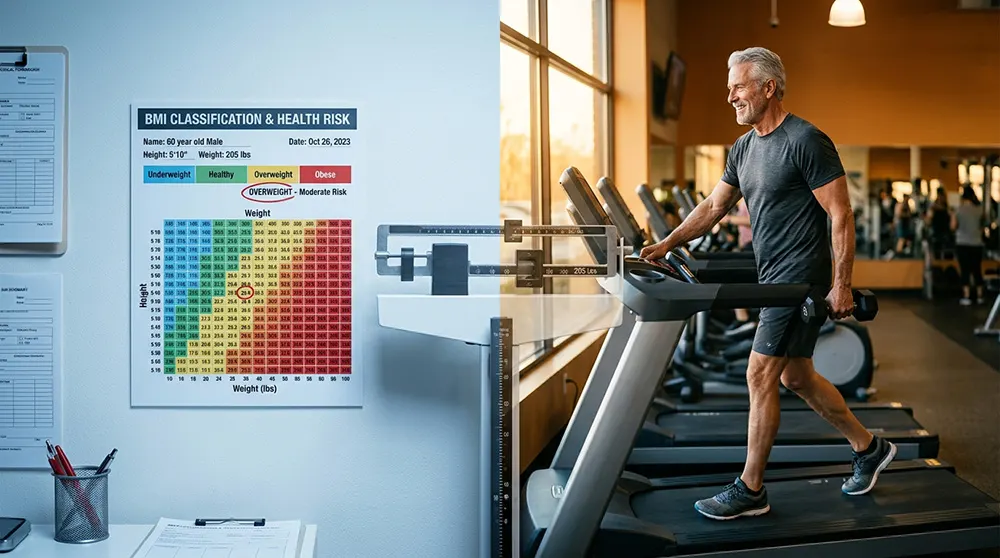
Why the Standard BMI Range Gets Interpreted Differently With Age
For men over 60, a BMI reading in the standard 'overweight' range doesn't automatically carry the same weight, sometimes literally, that it would for a 30-year-old. The formula is identical at every age. What changes is how much a single number can actually tell about someone whose body composition, muscle mass, and health priorities have shifted with the years.
This isn't a case for ignoring BMI after 60. It's a case for reading it differently — alongside strength, mobility, and function, rather than as a number to optimize in isolation.
Is BMI Interpreted Differently for Older Men
The calculation itself never changes: weight divided by height squared, the same formula used at any age. What shifts is the range some geriatric research treats as favorable, and the emphasis placed on the result relative to other health measures.
A BMI between roughly 23 and 27 is sometimes discussed as a reasonable range for men over 60, compared with the standard adult healthy range of 18.5 to 24.9. The reasoning behind this centers on two observations from aging research: some extra weight may offer a buffer during illness or recovery, and being underweight in older age is associated with its own set of risks, including frailty and reduced resilience that can outweigh the risks of carrying modestly more weight.
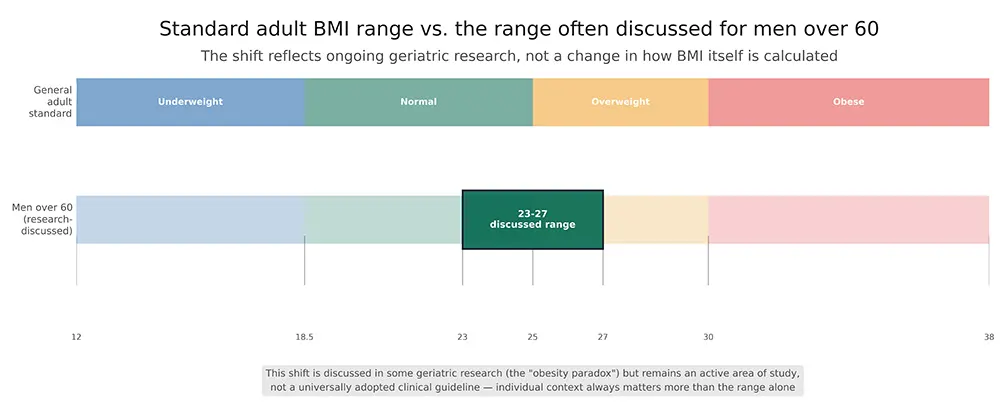
Figure 1: How the range discussed for men over 60 compares with the general adult standard. This shift reflects an active area of geriatric research, not a formal revision to how BMI itself is defined or calculated.
It's worth being direct about the limits of this research: the phenomenon sometimes called the 'obesity paradox' in older adults is genuinely studied and genuinely debated within the medical literature; it is not a settled recommendation to deliberately aim for a higher number, and it doesn't apply uniformly across all older adults or all health conditions. It's a reason to interpret a BMI reading with more nuance in this age group, not a target to pursue on its own.
A Worked Example
Concrete numbers make this easier to follow than the general explanation alone.
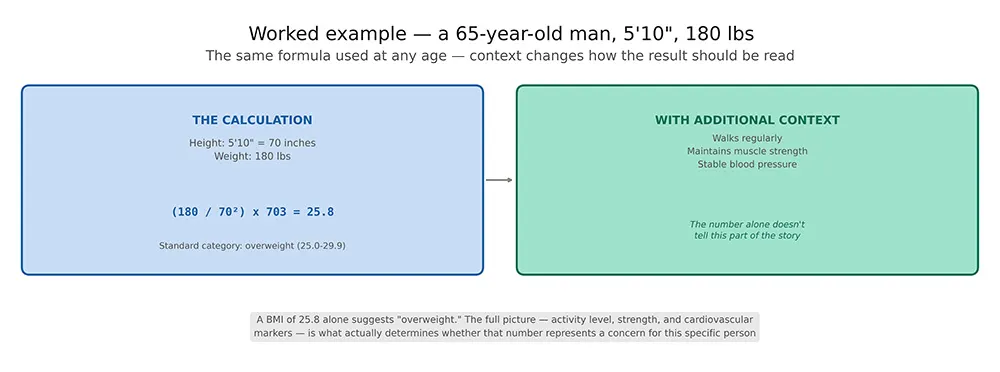
Figure 2: A 65-year-old man at 5'10" and 180 lbs calculates to a BMI of 25.8 — technically in the standard 'overweight' category. Whether that number represents any actual concern depends heavily on factors the calculation itself cannot see.
A BMI of 25.8 on its own places this man in the standard overweight category. But if he walks regularly, has maintained muscle strength, and has stable blood pressure, that same number reads very differently than it would alongside inactivity, muscle loss, and elevated blood pressure. The calculation doesn't change. What it means does.
What Matters More Than the BMI Number Alone
For men in this age group, three additional measures typically provide more actionable information than BMI by itself, not as replacements, but as the context that makes a BMI reading genuinely useful rather than potentially misleading.
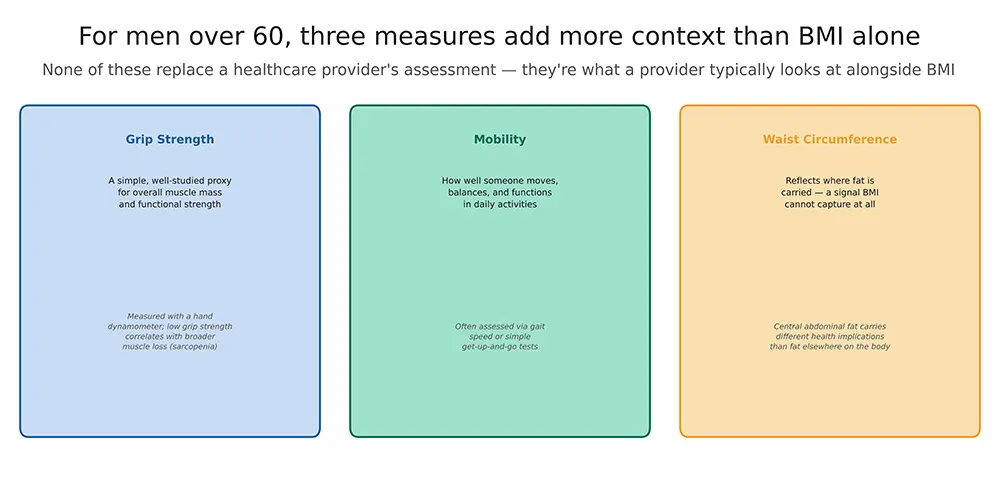
Figure 3: Grip strength, mobility, and waist circumference each capture something BMI structurally cannot. Together with BMI, they form a far more complete picture than any single measure alone.
Grip strength is a simple, well-studied proxy for overall muscle mass and functional strength, typically measured with a hand dynamometer. Declining grip strength correlates with broader age-related muscle loss, a pattern sometimes referred to clinically as sarcopenia, and is one of the more practical, low-effort measures a healthcare provider can track over time.
Mobility how well someone moves, balances, and completes daily physical tasks is often assessed through gait speed or simple functional tests. It reflects real-world capability in a way a static height-and-weight ratio cannot.
Waist circumference captures something BMI has no way to measure at all: where fat is actually carried on the body. Fat concentrated around the abdomen is associated with different health implications than fat distributed elsewhere, regardless of what the overall BMI number happens to be.
What Tends to Matter More Than a Specific BMI Target
For men over 60, three things generally matter more day to day than hitting a particular number on a BMI chart.
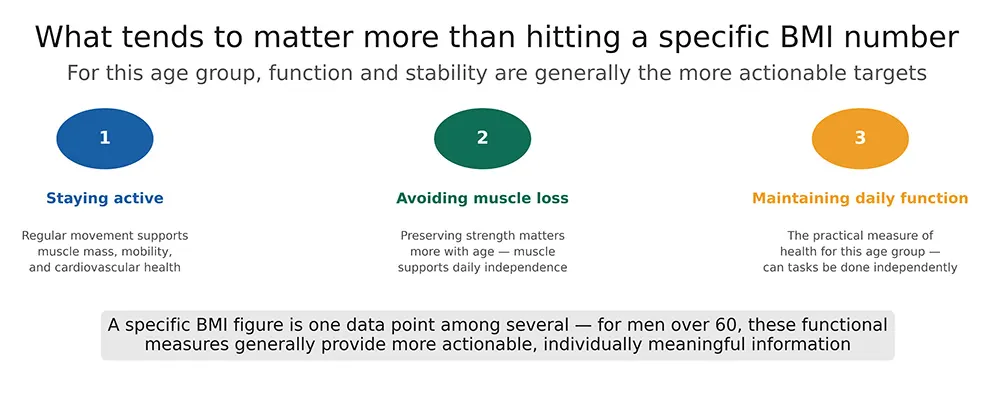
Figure 4: Staying active, preserving muscle mass, and maintaining daily function are the more actionable priorities for this age group — each one influences long-term health more directly than the BMI figure alone.
Staying physically active supports muscle mass, mobility, and cardiovascular health simultaneously; it's one of the few interventions that affects nearly every other measure discussed here at once. Avoiding unnecessary muscle loss matters more with age specifically, since muscle mass underpins the strength and balance that daily independence depends on. And maintaining daily function the practical ability to move, carry, climb stairs, and manage everyday tasks without assistance is, for this age group, a more meaningful measure of health than any single number derived from a height and weight ratio.
When to Discuss BMI With a Healthcare Provider
A BMI reading in any direction, at any age, is a reasonable prompt for a conversation with a doctor, not a number to interpret or act on alone. This is particularly true for men over 60, where the standard categories carry more caveats and individual context matters more than it does for a younger, generally healthier population.
A healthcare provider can weigh a BMI result alongside grip strength, mobility, blood pressure, existing health conditions, and personal history to get the fuller picture that determines whether a given number actually represents something worth addressing, and if so, what an appropriate and individualized approach looks like. That kind of personalized guidance is not something a general calculator, or an article like this one, is positioned to provide.
Frequently Asked Questions
Is a BMI of 25.8 concerning for a man over 60?
Not necessarily on its own. A BMI of 25.8 falls within the standard overweight category, but for a man over 60, that figure is generally read alongside activity level, muscle strength, and cardiovascular markers rather than in isolation. Context tends to matter more than the number by itself at this age.
Why is a slightly higher BMI sometimes considered acceptable for older men?
Some geriatric research has found associations between modestly elevated BMI and better outcomes during illness or recovery in older adults, a pattern often called the obesity paradox. This remains a genuinely debated area of research rather than a settled clinical recommendation, and it does not mean deliberately gaining weight is advisable. It's a reason for more nuanced interpretation, not a target.
What should be tracked alongside BMI for men over 60?
Grip strength, mobility or gait speed, and waist circumference are commonly discussed alongside BMI for this age group, since each captures something the BMI formula structurally cannot: muscle mass, functional capability, and fat distribution, respectively.
Does losing weight always improve health for older men?
Not automatically, and not in every case; it depends heavily on individual circumstances, including current muscle mass, overall health status, and why the weight is being carried in the first place. This is a question for an individualized conversation with a healthcare provider, not something a general guideline can answer responsibly.
Conclusion
BMI doesn't recalculate itself with age; the formula is identical at 30 and at 70. What changes is the context needed to interpret the result meaningfully. For men over 60, a reading in the standard overweight range is not automatically a concern, and a reading in the standard normal range is not automatically reassuring, without also considering strength, mobility, and how the body is actually functioning day to day.
The research suggesting a modestly higher BMI range for older adults is real, but it's genuinely debated and shouldn't be treated as a target to aim for. The more consistently useful approach for this age group is staying active, preserving muscle mass, and paying attention to functional capability, with a healthcare provider factoring BMI into that broader picture, rather than treating it as the whole picture on its own.